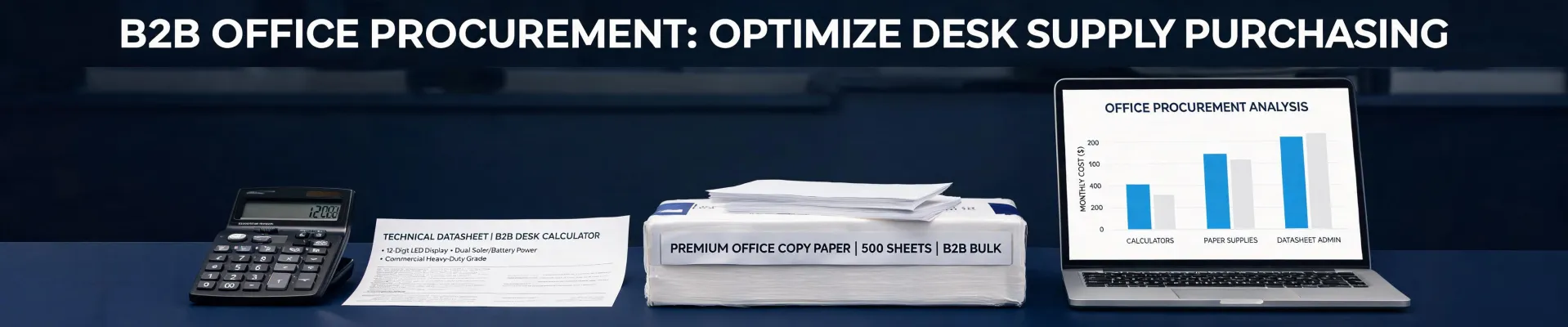
It was a Tuesday morning when the finance lead walked into my office holding a calculator with a dead screen. Third one that month. By the end of that year, I'd replaced twelve calculators across the company—some because they broke, some because someone "accidentally" dropped theirs down the stairwell, and honestly, a couple because a staff member just wanted a different one.
As an office admin, my first instinct was simple: we need better calculators. So I bought "better" ones. They cost more, looked tougher, and failed the same way.
That's when I stopped reordering and started asking an uncomfortable question: why do office calculators keep dying? The answer changed how we buy equipment.
The problem isn't the calculator. It's how we buy it.
Here's the uncomfortable truth: we were treating calculators like paperclips. One generic SKU, lowest price wins, handed to whoever asked. Nobody saw the person doing the calculating.
That works with paperclips. It doesn't work with calculators.
Because here's the thing I didn't get until I'd wasted about a year on this: calculators aren't one product. They're a whole category—basic, scientific, printing, graphing—and the differences matter more than the button count.
Our accountants, for instance, don't just calculate. They have to prove the numbers. When we finally switched to the Casio HR-300RC printing calculator for the finance team, I was genuinely surprised: it prints a paper record for every calculation, so "where did this figure come from?" finally has hard evidence behind it.
I should mention—I thought printing calculators were a gimmick at first. Who uses paper in 2025? Turns out auditors do. Auditors love seeing exactly where a number came from.
The pink calculator Casio models? When our receptionist asked for one, I rolled my eyes a little. It felt like buying a desk accessory. But it turns out those are fully functional calculators, not toys. And for a front desk, the color makes the first impression friendlier than the standard gray slab. Measurable ROI? I don't know. But how the office feels matters more than I used to admit.
Meanwhile, our engineers were quietly asking for Casio scientific models, and I kept buying the same basic one, because "calculator" on the request form meant "calculator" on the purchase order. I wasn't buying the wrong brand. I was buying the wrong category, for the wrong person, over and over.
What the one-size-fits-all approach cost us
Let me do the honest math.
By ordering generic models instead of matching the calculator to the role, we saved maybe $12–$15 per unit. Across roughly 30 calculators, that looked like a $400 win.
Then came the replacements. Twelve in twelve months. The finance associate who re-did a reconciliation because the cheap model's rounding didn't match the accounting software. The account manager whose calculator froze in a client call and made her look unprepared. The battery that always died at the worst moment.
The hidden cost wasn't catastrophic. But it was completely avoidable. And it fits a pattern I've seen all over procurement: we optimize the line item and ignore the workflow.
I did the same with a vendor in 2022. We saved $80 by using a cheaper supplier, then discovered they couldn't produce a proper invoice. Finance rejected the expense, and I ate $2,400 from the departmental budget. I should've known better.
The pattern repeats across office equipment. A department bought a Bambu Lab 3D printer to fix a prototyping bottleneck—the printer was fine, but the bottleneck was in the design review process, not the hardware. And the conference room printer? Everyone blamed the Brother printer drivers, but the real problem was that the network connection had changed and nobody updated it.
We blame the tool when we never diagnosed the need.
What worked for us (and what I'd honestly recommend)
After all that, I still don't believe in a "best" calculator. I do believe in the right one for the role.
- Finance and accounting: the Casio HR-300RC printing calculator. It's the paper-trail champion—auditors will thank you. It's tabletop-sized, so it needs desk depth. If your finance team is fully remote, this might be the wrong call: software alone may be enough.
- Reception and front-of-house: a pink calculator Casio model. Fully functional, looks good, friendlier first impression. If your brand demands gray, get gray. But the pink one isn't a gimmick.
- Engineering and technical staff: Casio scientific models. For schools or labs, ask the instructor which functions the curriculum requires before ordering.
The wider lesson—whether you're figuring out how to connect to a printer, adding a 3D printer to a workflow, or picking a calculator—is the same: the problem is usually the fit between the tool and the job, not the tool itself.
Bottom line
If your equipment keeps failing, don't order replacements yet. Walk around. Ask what the calculator is actually for. Then buy for the role, not for the shelf price. And if someone tells you they've found the one calculator that beats them all, ask: "Best for whom, doing what, how often?" The honest answer is probably "it depends."
Product note: Casio models mentioned are standard current retail lines. Pricing is based on publicly listed U.S. prices as of January 2025—the HR-300RC typically runs $40–$55, and standard pink Casio desktop calculators run $10–$15, excluding shipping. Prices vary by vendor. This experience reflects a mid-sized professional services office; industrial or educational environments will differ.

Elena Baptista
Elena Baptista is an office printing and imaging analyst covering laser and inkjet printers, multifunction devices, copiers, label and receipt printers, ink cartridges, toner cartridges, and drum units. She applies ISO/IEC 24734, ISO/IEC 24711, and ISO/IEC 19798 methods while comparing print speed, first-page time, duplex throughput, duty cycle, page yield, coverage assumptions, resolution, color consistency, energy use, and maintenance intervals. Her guides help offices, schools, dealers, and procurement teams match output volume, media handling, connectivity, consumable economics, service access, and fleet-management requirements.