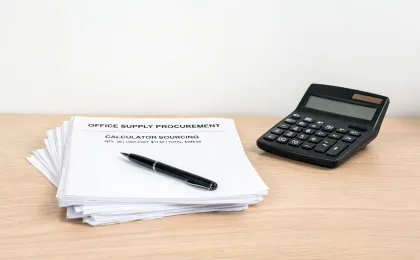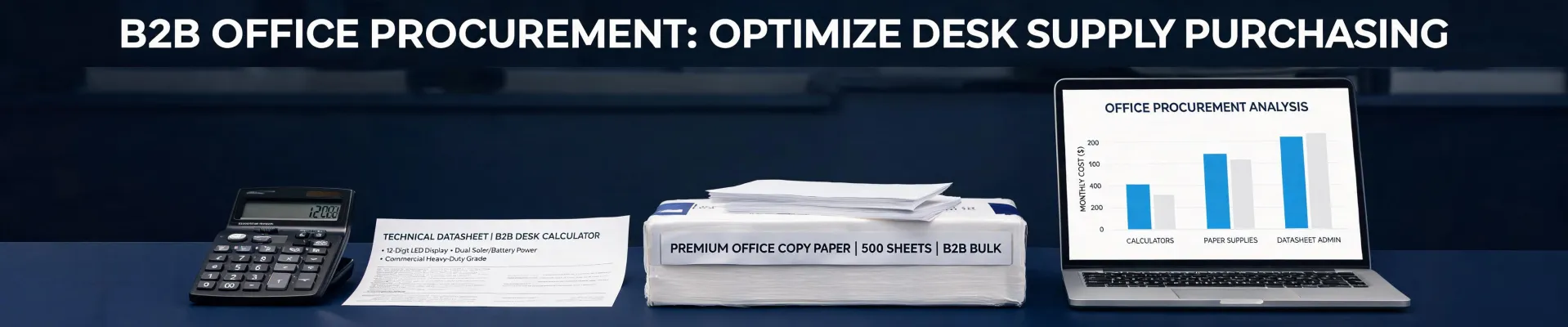
Why I Compare Products, Not Just Suppliers
I'm a quality/compliance manager at an office and school supplies distributor. I review roughly 200 SKUs every year before they reach customers. In 2025, I've rejected about 9% of first deliveries because the product didn't match the approved sample.
This article is not a best products list. It is the comparison process I run before approving an order. The same logic applies to suppliers, product photos, and hidden fees.
Here's something vendors won't tell you: the first price is almost never the final price. I've learned to ask what is NOT included before asking what the price is.
The vendor who lists all fees upfront, even when the total looks higher, usually costs less in the end.
A fuzzy photo, an unmeasured converter base, and a zipper that doesn't match the approved sample all add hidden costs later.
Casio Calculator: fx-300 Scientific Calculator vs fx-991ES PLUS
For general high school math and introductory science, the Casio fx-300 scientific calculator is my default recommendation. It's simple enough for algebra and statistics, durable enough to survive a backpack, and priced so a school can order in larger quantities.
For coursework that goes into matrices, vectors, simultaneous equations, or complex number arithmetic, I would choose the Casio fx-991ES PLUS. It offers more advanced functions and is a popular exam-room model for higher-level students. The exact function list depends on your market, so check the Casio official product page before you commit.
Here is the quality-control angle that surprises buyers: photo verification matters as much as price. If you compare a Casio fx-991ES Plus scientific calculator image on a marketplace with the image on Casio's page, the differences should be minimal. Keypad layout, model text, and brand mark should match. A blurry listing photo that doesn't clearly show the model is not a minor detail. For a batch of calculators, it is the first sign that other specifications might be wrong too.
Comparison conclusion: choose fx-300 for most school math and science; choose fx-991ES PLUS for higher-level work. Then verify the model image before ordering.
Standing Desk Converter vs Fixed Sit-Stand Desk
Once you've chosen the Casio calculator, the next issue is the desk under it. A standing desk converter is the lower-cost option if you already own standard-height desks. It gives height adjustment without replacing the furniture. A fixed sit-stand desk is more expensive and requires installation, but it is often the cleaner solution for new workstations.
When I compare standing desk converter quotes, I ask for the load capacity at standing height, not only at the lowest setting. Some converters rate their capacity at the lowest position, and the effective capacity drops as the platform rises. That hidden spec behaves like a hidden fee. I also check the footprint. A converter that extends beyond the desktop is a problem waiting for a fall.
For a fixed sit-stand desk, compare leg construction, motor warranty, and cable management. It is a bigger purchase, but it is easier to spec. If you're equipping a new office with 20 desks, a transparent quote for the full desk often costs less than retrofitting converters later.
Comparison conclusion: choose a standing desk converter for existing desks; choose a fixed sit-stand desk for new spaces or consistent ergonomics at scale.
Pencil Case: Clear Pouch vs Zippered Canvas
Pencil cases feel like a small item until they fail. In annual school supply orders, returns on pencil cases can outnumber returns on calculators. Zippers are the biggest culprit.
The clear pouch is the easiest to inspect. Students can see the contents, and a teacher can see if something is missing in seconds. The downside is material fatigue. Clear pouches can crack along seams if they are molded too thinly. A zippered canvas case is thicker and more polished, but it depends heavily on the quality of the zipper and stitching.
This is where I rely on the approved sample, not only the catalog image. In Q1 2024, we caught a batch of pencil cases where the zipper pull was set 4 mm lower than the approved sample. The factory called it normal tolerance. We rejected it because in a lot of 1,500, that mismatch becomes obvious and breaks the standard for the customer. The replacement arrived three weeks later and matched perfectly.
Comparison conclusion: clear pouch for visibility and lower budget; zippered canvas for durability and a more professional look. Both need a pre-production sample check before you approve a full order.
How to Get Permanent Marker Off Clothes
This is the stain conversation I never planned to include in a procurement guide. But every office has permanent markers, and every marker eventually meets clothes. If someone marks a calculator case or pencil case and misses, this is what to do.
Do not start by scrubbing with laundry detergent. Detergent alone lifts a little pigment but pushes the rest deeper. The better comparison is alcohol-based solvent versus detergent-only cleaning.
Put a paper towel under the stained fabric. Dampen another towel with rubbing alcohol, at least 70% alcohol by volume, and lightly dab the mark. Keep moving the stained spot over a clean section of the towel. Once the ink stops transferring, spot-treat with laundry detergent, wash in the warmest water the fabric allows, and air dry. Heat from a dryer can set any pigment that is left, so wait until the stain is completely gone.
People treat permanent marker as if the ink fuses into every fiber. In reality, most permanent inks use a solvent-based binder that sits on and around the fibers. Alcohol dissolves that binder, and detergent washes away the released color. That is why alcohol is the reliable first move, not a specialty cleanser.
Comparison conclusion: use alcohol first, detergent second, and skip the dryer until the stain is gone.
So What Should You Actually Order?
Here's the honest summary:
- For general math and science courses: the Casio fx-300 scientific calculator.
- For advanced high school or college engineering work: the Casio fx-991ES PLUS.
- For existing furniture and limited budget: a standing desk converter.
- For a new office or classroom buildout: a fixed sit-stand desk.
- For quick classroom checks: a clear pencil case.
- For longer service life and a professional look: a zippered canvas pencil case with a pre-production sample.
- For marker accidents: alcohol, detergent, and air drying.
No supplier should surprise you with the product after they surprise you with the price. Ask for the real photo, the real spec sheet, and the list of what is excluded. That comparison never goes out of style.

Elena Baptista
Elena Baptista is an office printing and imaging analyst covering laser and inkjet printers, multifunction devices, copiers, label and receipt printers, ink cartridges, toner cartridges, and drum units. She applies ISO/IEC 24734, ISO/IEC 24711, and ISO/IEC 19798 methods while comparing print speed, first-page time, duplex throughput, duty cycle, page yield, coverage assumptions, resolution, color consistency, energy use, and maintenance intervals. Her guides help offices, schools, dealers, and procurement teams match output volume, media handling, connectivity, consumable economics, service access, and fleet-management requirements.