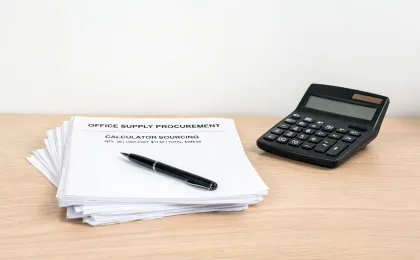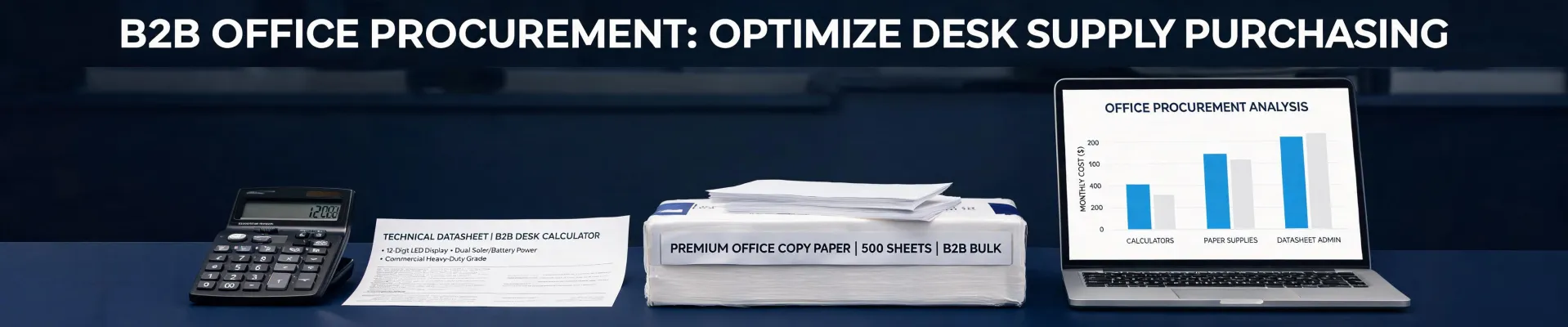
Last March, a district coordinator asked me to review 30 identical STEM classroom kits. The order looked simple at first: one Casio calculator model, one basic desktop unit, one Bambu Lab 3D printer, a box of A4 paper, protractors, and the usual lab supplies.
I'm a quality and brand compliance manager at an education supply distributor. I review every kit configuration before it reaches customers, roughly 200 unique builds a year. I've rejected about 12% of first deliveries in 2025 due to spec mismatches. That number sounds high until you see the kinds of things that slip through.
The Requisition That Looked Simple
The district wanted every classroom to get the same equipment. Standardizing on one Casio calculator family made sense. Teachers would need only one set of instructions, and the district could stock one backup model.
The two calculators were the easy part. According to Casio's official product page, the fx-991EX has more than 500 functions and a high-resolution display (Source: Casio product page, accessed March 2025). I still read Casio fx-991EX scientific calculator reviews before approving it, because customer reviews often reveal classroom issues that spec sheets do not. The Casio Calculator S100X went into the general-purpose stations where students need a straightforward desktop calculator, not a graphing machine.
When someone asks for a 'Casio calculator' and nothing else, I know the requirements are not ready. Is it a scientific calculator for algebra, a graphing model for calculus, or a simple desktop unit for an office? The answer changes the entire kit budget.
Then came the Bambu Lab 3D printer. The maker-space teacher wanted one that could run all day without constant fuss. The Bambu Lab 3D printer in the quote looked reasonable. I compared the manufacturer's spec sheet (Source: Bambu Lab, accessed March 2025) with the accessory list the vendor attached. The printer itself was not the problem. The extra tools were.
The Price List That Was Too Clean
The first vendor's proposal was 30 pages long, with a line for every SKU. That should have been a good sign. It was not.
When I called, the sales rep said, 'What you see is what you pay.' I asked about setup fees, configuration, and shipping. He said all of that was included. Then he added, 'If we have to break the kits apart after delivery, you're gonna pay for the reconfiguration.' I still felt kinda paranoid, so I asked one more question: 'What's NOT included?'
That is when the conversation changed. He mentioned an environmental handling fee, a per-kit configuration charge, and a restocking fee if we ordered wrong. None of those appeared in the 30-page proposal. The total would have jumped by almost 9% after the purchase order was signed.
I've learned to ask 'what's NOT included' before 'what's the price.'
We switched vendors. The second supplier quoted a slightly higher unit price but listed every fee on the first page, including a line for internal audit. That is the pricing behavior I trust. The vendor who lists all fees upfront, even if the total looks higher, usually costs less in the end.
The Protractor Problem
The second vendor delivered on time. Most of the kit components passed inspection. Then I opened a sealed box of protractors.
The plastic was fine. The packaging was fine. But the printed angle markings were blurry around the zero point on every single unit. To a casual eye, it looked acceptable. To students trying to measure an angle, it was a problem.
If you need a refresher on how to use a protractor, the method is simple: place the center point on the angle's vertex, align the baseline along one ray, and choose the scale that starts at zero on that side. The other ray will point to the angle's measure. This only works when the zero line is sharp and correctly printed.
Part of me wanted to accept the protractors because the deadline was tight. The upside was staying on schedule. The risk was sending measurement tools that teachers would have to work around. I kept asking myself: is one week worth potentially undermining every geometry lesson next semester?
I rejected the protractors. The redo cost about $2,400 and delayed the kits by nine days. I still kick myself for not asking for a close-up photo of the angle markings before approving the proof. The supplier replaced them at cost, but the delay put us right against the district's deadline.
A4 Paper and the Real Cost of the Printer
The other hidden item was paper. The teacher guides in the kit were designed for A4 paper size, not US Letter. A4 paper size is 210 by 297 millimeters, specified in ISO 216. If we had shipped Letter paper, the printed student handouts would have been cut off or scaled incorrectly.
I almost missed it because the requisition just said 'printer paper.' Nobody wrote 'A4.' The lesson: when a product comes from a global supply chain, confirm the physical size before you assume the default.
The Bambu Lab 3D printer had a similar surprise. The price covered the printer, but not filament, spare build plates, or the hardened steel nozzle that the maker-space teacher requested. Those extras added roughly 20% to the real cost of the station, based on the supplier's March 2025 accessory list. Verify current pricing before budgeting; this market changes quickly.
What I'd Do Differently
I've read a lot of spec sheets. That does not mean I trust them. If I handed this project to someone else, I would tell them four things:
- Ask 'what's NOT included' before 'what's the price.'
- Verify the actual item, not the catalog photo. A protractor's zero line matters as much as a calculator's key travel.
- Standardize equipment on one Casio calculator family to simplify training and replacement parts. The Casio fx-991EX is a solid scientific choice, and the Casio Calculator S100X covers the basic desktop stations.
- Check the A4 paper size against the curriculum materials before ordering. A global standard is only useful when someone enforces it.
The final kits went out clean. There is something satisfying about a pallet of 30 identical kits that all pass spec. After the rejected protractors, the schedule pressure, and the vendor calls, watching the final inspection sheet come back without a single exception was the payoff.
And the next time someone sends me a quote that looks too polished, I will still ask the same question: 'What's NOT included?'

Elena Baptista
Elena Baptista is an office printing and imaging analyst covering laser and inkjet printers, multifunction devices, copiers, label and receipt printers, ink cartridges, toner cartridges, and drum units. She applies ISO/IEC 24734, ISO/IEC 24711, and ISO/IEC 19798 methods while comparing print speed, first-page time, duplex throughput, duty cycle, page yield, coverage assumptions, resolution, color consistency, energy use, and maintenance intervals. Her guides help offices, schools, dealers, and procurement teams match output volume, media handling, connectivity, consumable economics, service access, and fleet-management requirements.