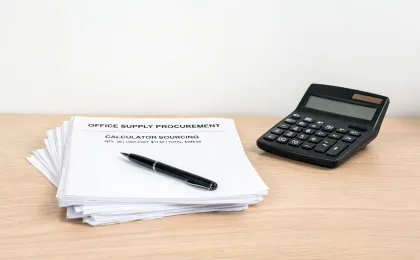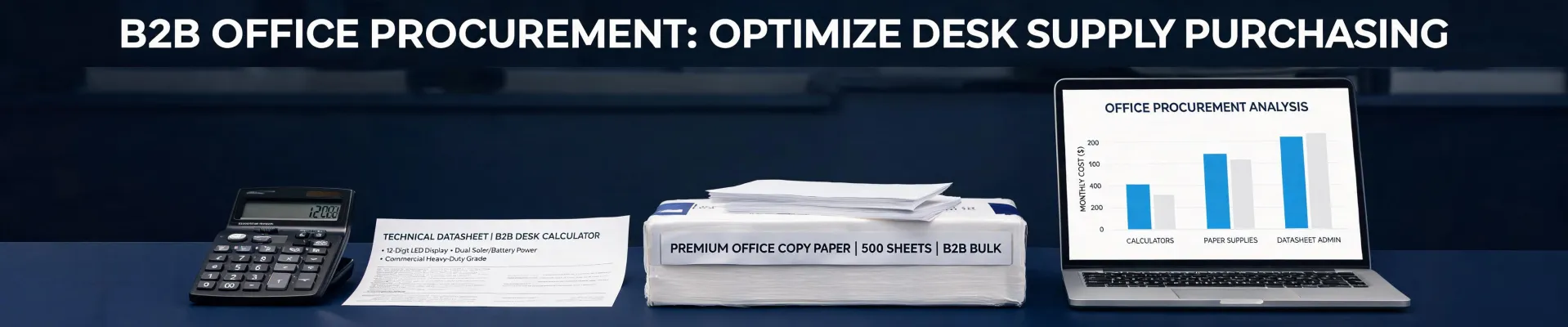
I'm a quality/compliance manager at an office-supply distributor. I review every delivery before it reaches customers—roughly 200 unique items a year, and a large share of those are Casio calculators. If you'd asked me in early 2021 what a defect looked like, I would have given you a simple checklist: unit doesn't power on, a key stops registering, the display has missing segments. After nearly five years of managing rejects, I've come to believe the most expensive defect is far less visible. It's not a broken calculator. It's a mismatch between the calculator and the job it was bought for.
The mismatch almost always starts with the same behavior: someone types “casio-calculator” into a search box, clicks the first well-reviewed result, and treats that as a technical specification.
The five-star order that should never have reached me
In spring 2023, an order crossed my desk that I still think about, not because the product was bad, but because the process was broken. A school system needed 1,800 calculators for an exam administration. The internal purchase request didn't include a model number. It literally said “Casio calculator”—something like that, with no segment, no approved-model reference, nothing. Our sales team found a genuine Casio unit with glowing online reviews and submitted the order.
The unit itself was fine. It powered on, the keys had a clean tactile feel, and the display was consistent across every sample I checked. The problem was that the model wasn't on the state's approved calculator list for that exam. The school caught it during their own verification step. Return freight, restocking, and an emergency reorder of the correct model cost roughly $22,000. Nobody at Casio made a defective calculator. Our process created the defect.
That's the frustrating part for me: the failure was avoidable from the very first search. The review said the product was great. I'm sure it was great—for whoever wrote the review. But a review from one person using one unit in one setting is a weak foundation for 1,800 units in a regulated testing environment.
The deeper issue: quality is a match, not a property
In quality management, there's an old phrase: fitness for use. It sounds academic, but it explains most calculator order failures I see.
A product cannot be “the best” in the abstract. It can only be the best for a defined job.
Take a graphing calculator with a computer algebra system. Reviewers love it; it's powerful and versatile. But for an exam that only permits non-CAS calculators, that same device is disqualified before it leaves the box. A desktop printing calculator can be a dependable workhorse in an accounting office, yet completely inappropriate in a quiet exam hall where the sound of printing would disrupt every student. Same brand. Same build quality. Different context, different verdict.
When you buy one calculator for yourself, the unit is the whole quality picture. When you buy calculators for a school, an office, or a government department, the batch is the quality picture. You need every unit to match the intended use, not just the first one out of the carton. That's why I started telling our team to define the context before looking at reviews.
Generic search terms teach less than people assume
I see the same search behavior in nearly every product category, not just calculators. People search “epson printer drivers” and end up downloading the wrong driver because they ignored the machine's exact model number. People search “bamboo labs 3d printer” when they mean Bambu Lab—and then realize the setup guide depends on which specific printer they own. Someone with a stained rug will search “how to get acrylic paint out of carpet,” but the safest method depends on the carpet fiber, the paint age, and what's already been tried.
None of those queries is useless. They're starting points. The failure comes when a starting point is treated as a finishing point.
The same problem shows up in phrases like “casio sl-300sv handheld calculator reviews.” That search can tell you how a compact model feels in daily use. It will not tell you whether that model is appropriate for a university lab, a retail cash office, or a state exam. And a search for “casio s100x calculator” may land on a model page, but a model page is not a use case. I need to know who will use it, where, and under what rules before I can approve it.
This is also where the industry has quietly changed. Five years ago, a broad query like “casio-calculator” returned a small set of familiar bestsellers, so the risk was lower. In 2025, the product line covers basic, scientific, graphing, desktop, and printing calculators, and each of those segments serves different work. What was best practice in 2020—search broadly and pick the top-rated option—is not how I would recommend buying in 2025. The fundamentals haven't changed; the product landscape has.
What I do instead: spec first, review second
Now, when a request says only “Casio calculator,” I send it back. It's not an act of bureaucracy. It's the cheapest quality control step we have.
- Define the job. What will the calculator actually be used for? Who will use it? Are there regulations, exam rules, or curriculum requirements that constrain the model?
- Translate the job into a model or approved list. If the request names a specific model like the casio s100x calculator, we verify that the model's functionality fits the job. If it doesn't, the model is rejected, regardless of how well it's rated.
- Use reviews as a final sanity check, not a selection tool. Reviews are useful for spotting common annoyances like stiff keys or hard-to-read displays. They are not a substitute for a specification.
- For bulk orders, sample from multiple cartons. I check units from different parts of the batch, not just the first carton. If a school is receiving 300 calculators, I want to know how the 78th unit and the 214th unit behave, not just the first one.
I also lean on the official source when uncertainty creeps in. According to Casio's product information at casio.com, the calculator lineup is split into distinct segments for basic, scientific, graphing, and desktop work. That seems obvious, but it prevents the exact mistake I described earlier: buying a perfectly good product from the wrong segment.
The $22,000 mistake changed how our team handles calculator requests. We now reject any internal order that lacks a use case, and first-delivery rejections have dropped by more than half. If you ask me, the review was never the real problem. The real problem was letting a search result make a buying decision.

Elena Baptista
Elena Baptista is an office printing and imaging analyst covering laser and inkjet printers, multifunction devices, copiers, label and receipt printers, ink cartridges, toner cartridges, and drum units. She applies ISO/IEC 24734, ISO/IEC 24711, and ISO/IEC 19798 methods while comparing print speed, first-page time, duplex throughput, duty cycle, page yield, coverage assumptions, resolution, color consistency, energy use, and maintenance intervals. Her guides help offices, schools, dealers, and procurement teams match output volume, media handling, connectivity, consumable economics, service access, and fleet-management requirements.