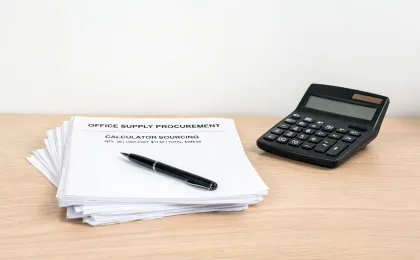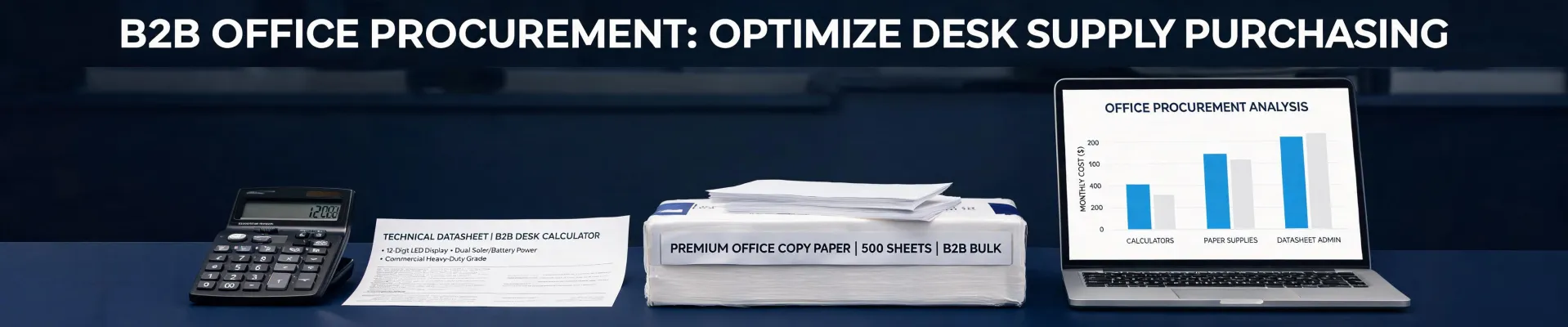
The most expensive Casio calculator I ever ordered was the cheap one.
I don't mean the list price was high. I mean the total cost was high—because I skipped a check that would have taken ten minutes, and then I had to spend three weeks managing the aftermath.
I'm an office administrator for a 220-person training and engineering company. I handle roughly $120,000 a year in office supply purchasing across nine vendors, and I report to both operations and finance. That last detail matters more than you'd think. It means every wrong order gets double scrutiny.
When I first took over purchasing in 2020, I assumed the lowest quote was basically the whole game. I want to say I learned that lesson in about six months, but honestly it took longer. What changed me were the follow-ups: the finance rejection, the annoyed department lead, the 'can you just check the model number next time?' email.
So here's my argument: in procurement, prevention beats cleanup. Every single time. And I'd rather check twice before ordering than explain a reorder to my VP.
The Casio Calculator That Made Me a Checklist Person
Our engineering and training teams use a lot of graphing calculators. The model I order most often is the Casio calculator fx-9750GII. It's not the most powerful Casio graphing calculator you can buy, and I'm not going to claim it is. But it's the one our instructors and engineers already know, and that matters more than a spec sheet feature list.
The full Casio-calculator lineup spans everything from basic scientific models to the fx-CG series to desktop printing calculators. The point for us isn't the unit price of one calculator. It's compatibility and battery life across the whole pool of devices. I learned this the hard way. In 2021, I almost approved an order for forty graphing calculators based on a price list. The numbers said go with the cheaper model. My gut said call the department lead first. I made that call, and it turned out the cheaper model had a completely different button layout. A different layout means retraining time. Retraining time means the training lead is annoyed, and no one wants an annoyed training lead.
The numbers said order the cheaper calculators. My gut said call the department manager first. I called.
I remember reading in the Lincoln Journal Star—I might be mixing this up with another local news article—that a school district switched to Casio graphing calculators at least partly because the battery life made it through a full school day. That matches what we see in our certification sessions. The fx-9750GII doesn't shut off in the middle of a proctored test. That's a boring thing to say, but it's the exact thing a buyer should care about.
A few people ask why I don't just pick one model and stop thinking about it. That's actually what I try to do. The fx-9750GII has been reliable for us, and Casio's education models tend to keep the same button logic across the lineup. That makes a shared pool easier to manage and training easier. I'd rather spend one afternoon updating a product spec sheet than three weeks re-teaching a department. The model itself didn't cost more. The verification cost nothing. That twenty-minute phone call prevented what would have been a three-week cleanup.
Printer Paper Is a Prevention Purchase, Whether It Feels Like One or Not
Nobody gets a standing ovation for buying printer paper. Until the copier jams. Then it's suddenly an emergency.
We used to buy the cheapest 20-lb multi-purpose paper we could find. It worked fine in some printers and not in others. The cheapest paper was cheaper per ream, but it was not cheaper per page if you count service calls. After the second jammed tray in a month, I switched the shared machine rooms to 24-lb paper. The blank stare from the finance team when I submitted the new line item was predictable. But the service-call log told the story: we went from almost monthly IT tickets about paper feed issues to zero in the next quarter. The surprise wasn't that the nicer paper worked. It was that no one had been tracking the service-call cost.
I also keep USPS pricing pinned to my desk. According to USPS (usps.com), as of January 2025, a First-Class Mail letter (1 oz) is $0.73, and a First-Class Mail large envelope (1 oz) is $1.50. The additional ounce for large envelopes is $0.28. That difference matters when a mail merge goes from letters to flats because the paper is too heavy or too stiff. We mail a fair number of invoices, so I pay attention to those thresholds. A standard #10 envelope with a folded sheet fits USPS letter size as long as the thickness stays under 0.25 inches and the weight stays under 1 ounce. That prevents a separate headache, too.
I also watch how 'recyclable' gets used on paper packaging. Per FTC Green Guides (ftc.gov), environmental marketing claims have to be substantiated. So if the box doesn't say what it means, I don't build a purchasing decision around it. That's another form of prevention: don't buy a story, buy a spec.
The Permanent Marker Problem Is a Supply Closet Problem
Here's the real confession. I've searched 'how to get permanent marker out of clothes' on my phone after three separate incidents involving the same employee and a whiteboard. I'm not proud of that.
What finally fixed it wasn't a better stain remover. It was separating the permanent markers from the dry-erase markers in the supply closet. Simple. Cheap. Nobody had to change their behavior—they just had to reach for the right tray. Before that, I was essentially choosing cleanup over prevention. I was buying the cure on repeat instead of asking why the problem kept happening.
After the third time, I was ready to put a padlock on the supply closet. What finally helped was a label maker. That's the pattern I see in purchasing over and over: the fix is usually boring, and the boring fix is the one people skip. So I made myself stop skipping it.
The Counterintuitive Part: Vet the Vendor Before the Product
Everyone talks about comparing product specs. The thing that actually bit me was the vendor.
In 2022, I found a great price from a new supplier. The calculator quote was about 15% lower than our regular vendor. I placed the order. When the invoice arrived, it was a handwritten receipt with no tax ID. Finance rejected the expense. I had to spend the department budget to cover the cost and then spend even more time explaining it. The total cost of that 'savings' ended up somewhere north of $600.
I used to think people who said 'check the vendor first' were being dramatic. I only believed it after I ignored it. Now I verify invoicing capability, order fulfillment history, and return terms before I compare unit prices. It's not the most exciting check, but it's the one that saves the most money.
This is why prevention is the right lens for procurement. The actual buying is the easy part. The messy part is the mistake after the purchase. So I'd rather spend ten minutes verifying a Casio calculator model or a printer paper spec than five days explaining to both operations and finance why we have the wrong one.
So What About 'Just Buy the Cheapest Thing'?
I hear that argument a lot. I used to make it. If you're a one-person office, buy the inexpensive calculator and the basic paper, and you'll probably be fine. I'm not going to tell you it's wrong for your situation.
But for a company that orders in bulk, the cost of a wrong order gets multiplied. One calculator mistake is an annoyance. Forty calculator mistakes are a departmental meltdown. That's why I'd rather check twice. Not because I enjoy bureaucracy. Because the cleanup always costs more than the check.
There are three checks I run on every order over $500: Have I confirmed the model number with the person who actually uses it? Have I verified the vendor can invoice correctly? Have I worked out what a reorder would cost if I'm wrong? That's it. No complicated software. Just a checklist that has saved me from repeating my own mistakes.
Bottom line: the product is not the problem. The missing verification is the problem. Figure out what to check, then check it before you order. It's the cheapest kind of insurance in purchasing.
And if you still need to know how to get permanent marker out of clothes, I understand. But maybe also check the supply closet.
Elena Baptista
Elena Baptista is an office printing and imaging analyst covering laser and inkjet printers, multifunction devices, copiers, label and receipt printers, ink cartridges, toner cartridges, and drum units. She applies ISO/IEC 24734, ISO/IEC 24711, and ISO/IEC 19798 methods while comparing print speed, first-page time, duplex throughput, duty cycle, page yield, coverage assumptions, resolution, color consistency, energy use, and maintenance intervals. Her guides help offices, schools, dealers, and procurement teams match output volume, media handling, connectivity, consumable economics, service access, and fleet-management requirements.