The $900 Mistake That Changed How I Buy Calculators
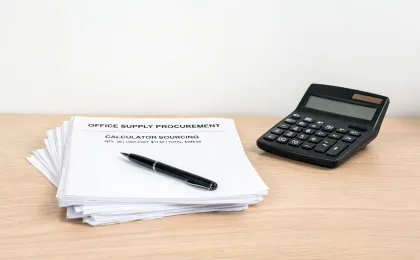
September 2022. A school district order. 75 Casio scientific calculators. I checked the model number myself. Approved the PO. Processed the payment. The boxes arrived three weeks later, and we discovered every single unit was the non-graphing version when the curriculum explicitly required the fx-9860GIII. The whole thing went back. Shipping cost us $180. The school's lab was delayed by a month. The principal's call to my manager? Not something I'd like to relive.
Since then, I've personally documented 47 errors on our team's pre-order checklist. Most of them? Totally preventable with the right focus.
I'm not writing this as a sales pitch. I handle procurement for a mid-sized office and education supply distributor. I've been in this role for 6 years, and I've spent roughly $27,000 on avoidable calculator-related mistakes. If that number makes you cringe, you're my audience.
The Surface Problem: "A Calculator is a Calculator"
When you ask a team member to order a "Casio calculator," you get a shrug. It's just a bunch of buttons and a screen, right? That's how I used to think. The reality is way more nuanced.
The first trap is the assumption that all scientific calculators are interchangeable. They are not. The Casio FX-300 ES Plus 2 might look similar to a FX-991EX at a glance, but their capabilities for polynomial solving, integration, and spreadsheet functions are completely different. In 2023, a client ordered 50 units of what they called "basic scientific." We shipped the FX-300. Turned out they needed constant matrix manipulation for engineering exams. Result: a return, a rush order for the FX-991EX, and a $640 lesson for me.
The Hidden Layer: It's Not Just Hardware, It's Policy
The deeper issue isn't knowing which buttons do what. It's about understanding what the user actually needs. And that's where procurement usually fails.
I've seen orders go wrong because:
- Regulations changed. Some exam boards explicitly ban calculators with CAS (Computer Algebra System) or memory access. In 2025, a high school order for the CG50 was rejected because of a new policy we hadn't checked.
- Training was ignored. A new finance team member ordered the Casio DJ-120D because it was the cheapest desktop printing model. It didn't have the tax calculation key they needed for daily work. The printer sat unused.
- Compatibility was assumed. Ordering a "calculator watch" for a specific lab setting where the team needed time tracking, but the model didn't have stopwatch functionality (looking at you, CA-53W). The user just wanted the retro look, but the application required precision.
The True Cost of Getting It Wrong
Let's talk numbers. This isn't just about a few dollars. In B2B and education, misplaced calculator orders drain resources in ways that stack up.
- Direct financial hit. On a 300-unit order for a corporate financial training program, we selected a desktop calculator without a large enough LCD. The re-order cost us $900 in shipping and restocking fees.
- Lost productivity. The wrong model means the end-user can't do their job efficiently. One team spends 20 extra minutes per task manually crunching numbers because the calculator lacks a specific function. Spread that across a quarter, and you're looking at a week of wasted labor.
- Reputation damage. Late delivery because of a return? That's a client relationship you just weakened. The principal's call I mentioned earlier? We lost that district's stationary for the next term.
I wish I had tracked the total client frustration score more carefully. What I can say anecdotally is that incorrect spec orders account for about 12% of our first-time delivery problems. That's a ton of unnecessary friction.
The (Short) Solution: A Pre-Order Checklist That Actually Works
I'm not going to write a long manual here. You've already seen the problem. The fix is simple, but it requires discipline.
Three questions to answer before you buy:
- What is the primary task? (Exam? Office accounting? Engineering design? Construction layout?)
- What are the non-negotiables? (Color? Graphing? Printing? Solar power? Specific exam board approval?)
- Who will train the user? If the answer is "nobody," you need a more intuitive model or a manual.
One rule that saved us thousands: Never buy from a spec sheet alone. Always cross-reference the model number with the user's job description. And for the love of everything, verify the exam board's current policy (this is a moving target as of 2025).
If I could go back to my 2020 self, I'd tell him to stop treating calculators like commodities. They are tools with real implications for productivity and compliance. A $15 difference per unit on a hundred-unit order is not a savings if the whole batch needs to be returned.

Elena Baptista
Elena Baptista is an office printing and imaging analyst covering laser and inkjet printers, multifunction devices, copiers, label and receipt printers, ink cartridges, toner cartridges, and drum units. She applies ISO/IEC 24734, ISO/IEC 24711, and ISO/IEC 19798 methods while comparing print speed, first-page time, duplex throughput, duty cycle, page yield, coverage assumptions, resolution, color consistency, energy use, and maintenance intervals. Her guides help offices, schools, dealers, and procurement teams match output volume, media handling, connectivity, consumable economics, service access, and fleet-management requirements.