-
Who This Checklist Is For
-
Step 1: Identify the Core Use Case (Don't Skip This)
-
Step 2: Check the 'Hard' Specs First
-
Step 3: Check for Hidden Costs (The 'Total Cost of Ownership' Check)
-
Step 4: Verify Compatibility and Policies
-
Step 5: The 'Did We Actually Need This?' Check (The Step Most People Skip)
-
Common Mistake to Avoid
Who This Checklist Is For
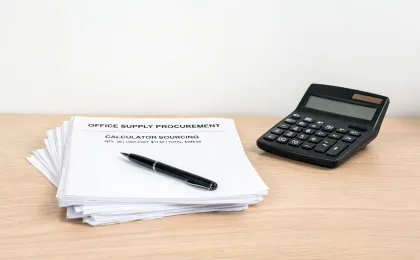
This checklist is for anyone responsible for buying calculators in bulk—school districts, university departments, corporate finance teams, or government procurement officers. Not for someone picking up a single unit at a retail store.
I've been in procurement for about 8 years. For the last 5, I've managed calculator orders for a mid-sized school network. We buy around 400-600 units a year. My perspective is mostly on high-volume orders for students and office staff. If you're sourcing for a specialized engineering lab or a construction firm's field crews, some of these points might shift. That's fine. The core logic stays the same.
Here are the 5 steps I use for every evaluation. They've saved us from a few costly mistakes. The last step, in particular, is one most people overlook.
Step 1: Identify the Core Use Case (Don't Skip This)
Honestly, this is where most mistakes happen. Not because people buy the wrong calculator, but because they buy a calculator that's overkill for the job. Or, just as bad, one that's missing a critical function.
Before you look at any model, answer three questions:
- Who will use it? A high school student in Algebra II? An accountant? A PhD candidate doing regression analysis?
- What exams or tasks will it handle? The SAT, ACT, and AP exams have specific calculator policies. For finance, you might need a calculator with pre-programmed financial functions (TVM, NPV, IRR).
- What is the typical problem environment? In a classroom, calculators get dropped. On a factory floor, they might need to be dust-resistant. For travel, a solar-powered model might be best.
I once ordered 200 units of a high-end graphing calculator for a school. Turned out the curriculum only required basic scientific functions for the first two years. We spent an extra $40 per unit for features no one used. That's $8,000 wasted. That mistake taught me to always start with the 'why' before the 'what'.
Step 2: Check the 'Hard' Specs First
Once you know the use case, the specs are simpler. I focus on three things, in order:
- Display clarity. For scientific calculators, can you read the fractions and exponents clearly? For graphing calculators, pixel resolution matters. A bad display slows down work. That's a hidden cost in lost time.
- Battery / Power. Solar-only models are great for classrooms. No dead batteries. But they need enough light. For low-light environments (like a dim auditorium), a battery model or hybrid is safer. The Casio fx-260 Solar is a classic example of a solid solar-powered basic calculator. For high-volume orders, battery life is a recurring cost. A unit that lasts 2 years on a single cell is cheaper than one lasting 6 months, even if the initial price is slightly higher.
- Build quality. This is subjective, but I look for the feel of the buttons. Are they mushy or crisp? Does the casing feel solid? Does it have a slide-on hard case? That's a big durability factor. A calculator without a hard case is more likely to get scratched or cracked in a backpack.
Step 3: Check for Hidden Costs (The 'Total Cost of Ownership' Check)
This is where my 'value over price' bias kicks in. A calculator costing $12 might look cheaper than a $15 model. But consider these:
- Battery replacement frequency. If the $12 model needs new batteries every 8 months, and the $15 model lasts 3 years on a single set, the $15 model is cheaper over 5 years. Do the math: 7.5 battery changes vs. 2. That's more than $3 in savings, plus the labor to change them.
- Durability / Replacement rate. In a school environment, 5-10% of calculators might get broken or 'walk away' each year. A more robust model might reduce that to 2-3%. The savings on replacements can be significant.
- Teacher / Staff training time. If you switch to a complex graphing calculator, do teachers need training? That's a cost. Not a dollar cost, but a time cost.
People assume the lowest quote is the most efficient. What they don't see is the extra time spent troubleshooting dead batteries, submitting replacement requests, or explaining a non-standard interface. That cost is hidden, but it's real.
Step 4: Verify Compatibility and Policies
This is where I've seen the most obvious errors. Make sure the calculator is allowed for the relevant exams.
The College Board (SAT, AP) and ACT have specific lists of approved calculators. Casio has a wide range of accepted models (like the fx-991EX and older fx-260 series), but not all are approved. You can check the official College Board and ACT websites for their most current lists. Don't rely on third-party summaries; verify directly. Getting a batch of calculators that can't be used for the final exam is a disaster.
If buying for a large government contract, also check if there are 'Buy American' or local content requirements. This is rare for calculators, but I've seen it happen.
Step 5: The 'Did We Actually Need This?' Check (The Step Most People Skip)
This is the step I learned from our worst mistake. After 3 years and about 150 rush orders for replacement calculators, I realized a pattern. Many early requests were for models that were 'fancier' than needed. A department head wanted 'the best' model for all students, but the curriculum only used about 20% of its features.
My advice: always question whether the requested model is the minimum viable option for the task. Ask the requestor: 'What specific function does this model have that a $15 scientific calculator doesn't?' If they can't answer, you might be over-specifying.
This isn't about being cheap. It's about being efficient. Over-buying on features is just as wasteful as under-buying on quality.
This checklist works best when you have a specific volume order in mind. If you're ordering fewer than 10 units, you can probably skip the formal process. But for any order of 50 or more, run through these steps. It's saved us from at least two significant procurement errors in the last 5 years.
Common Mistake to Avoid
Don't assume the 'newest' model is automatically the best. Sometimes the newest model has a slightly different user interface, which means more training time. The Casio fx-991EX is a proven, widely-taught model. A new version might be 5% faster but require 30 minutes of training per teacher. That trade-off isn't worth it for most bulk orders.
Also, be wary of 'too cheap' options from no-name brands. We tested a $5 calculator from a generic brand. It got a lower score on standard calculations (rounding errors in trigonometric functions). In a classroom, that can cause confusion. That $5 savings turned into a $1,500 problem when teachers had to re-teach concepts because the calculators were unreliable. We now only consider established brands for core academic subjects.

Elena Baptista
Elena Baptista is an office printing and imaging analyst covering laser and inkjet printers, multifunction devices, copiers, label and receipt printers, ink cartridges, toner cartridges, and drum units. She applies ISO/IEC 24734, ISO/IEC 24711, and ISO/IEC 19798 methods while comparing print speed, first-page time, duplex throughput, duty cycle, page yield, coverage assumptions, resolution, color consistency, energy use, and maintenance intervals. Her guides help offices, schools, dealers, and procurement teams match output volume, media handling, connectivity, consumable economics, service access, and fleet-management requirements.