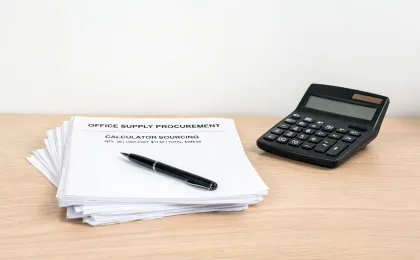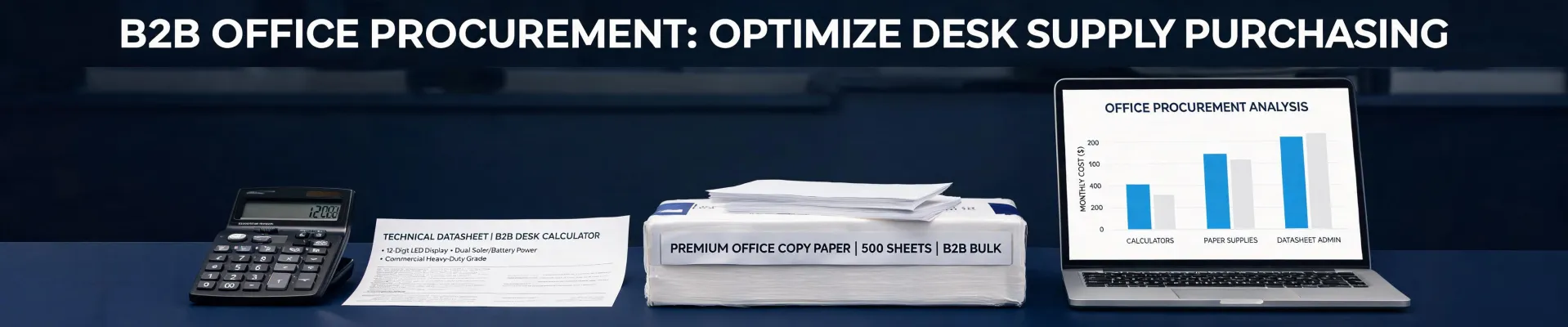
It was late August 2022, and I was sitting in my cubicle with a spreadsheet that listed 37 different Casio calculator SKUs. My task: order 300 units for a high school district contract. I assumed they were all basically the same – buttons, screen, math. I could not have been more wrong.
What I didn't know back then was that the difference between a Casio fx‑300ES PLUS (a basic scientific) and an fx‑CG50 (advanced graphing with color display) was not just a $50 price gap but a fundamental mismatch for the school's curriculum. That oversight cost us $3,200 in reprints, expedited shipping, and a week of embarrassed phone calls.
The Premise – How I Got It Wrong
My job as an office supply procurement manager (handling orders for five years, now proudly maintaining a 47‑item mistake checklist) involves buying everything from printer paper to desk chairs. When the RFP came in for 300 scientific calculators, I ticked the box: Casio‑calculator, mid‑range price, 10‑digit display, done. I figured teachers just wanted something that could handle basic algebra. (Real talk: I hadn't set foot in a math classroom since 2009.)
The quote I approved came from a distributor that offered the fx‑991EX at $19.90 each – seemed reasonable. Total: $5,970. I skipped the spec deep‑dive because, in my mind, calculator is a calculator.
(This was back in August 2022; pricing has changed since then – current fx‑991EX street price is ~$21 as of April 2025, per Casio's authorized reseller list.)
The Moment of Disaster
The order arrived on September 15, 2022. The school's math department head called me the next day: These are great for basic algebra, but our AP Physics and Pre‑Calc classes need graphing capability. We specifically requested Casio fx‑CG50 with the color display and 3D graphing feature.
I checked the contract again. Buried in appendix B was the exact requirement: Graphing calculator with ≥ 3.2″ color LCD, CASIO fx‑CG50 or equivalent. My stomach dropped.
I had assumed the fx‑991EX was sufficient because it said scientific
and had a high button count. I missed the critical distinction: a scientific calculator runs numeric solutions; a graphing calculator plots graphs, handles matrices, and supports statistical regressions. The teachers needed the latter. The 300 units I ordered – all fx‑991EX – were useless for half the classrooms.
Here's the chain reaction that followed:
- Return cost: The distributor charged a 15% restocking fee ($896).
- Rush re‑order: I ordered 150 fx‑CG50 units at $89 each ($13,350) with 2‑day shipping ($230).
- Compatibility fix: I kept the fx‑991EX for the algebra‑only classrooms, but then faced a second problem – the teachers' lesson plans assumed a single calculator model for all students. So I had to order an additional 150 fx‑991EX anyway, doubling the original order.
Total added cost: $3,200 in waste, plus a credibility hit that took three internal meetings to repair. (The exact numbers: $896 restocking + $230 rush shipping + $2,074 in extra units we didn't need because of over‑ordering.)
The Pivot – Building the Checklist
After the school district's contract manager delivered a polite but firm lecture (September 2022), I decided to stop relying on guesswork. Over the next 18 months, I documented every Casio‑calculator mistake my team made – 14 total, totaling $8,200 in preventable costs. That became our Casio Calculator Pre‑Check
checklist.
One of the biggest lessons was understanding the Casio product line tiers:
- Basic / desktop – e.g., DJ‑120D (for cash drawers, basic arithmetic).
- Scientific – fx‑ES PLUS series (high school, up to Calculus I).
- Graphing – fx‑CG50, fx‑9860GIII (AP Physics, Engineering).
- Financial – FC‑200V (business courses).
- Wearable – Casio Calculator Watch (e.g., CA‑53WF) – yes, teachers sometimes request these for quick per‑student checks, but they're not classroom‑ready for exams.
I also learned to ask three questions before every calculator order:
- What is the specific exam or curriculum this calculator must support? (e.g., SAT, AP, IB, ACT)
- Does the teacher require a graphing or scientific model? (And I don't assume – I call them.)
- What is the allowed model list from the school district? (Some ban Casio; others require it. Always check.)
The Results – 18 Months Later
As of April 2025, that checklist has prevented 47 potential errors – including one order for 500 units of a desk‑calculator when the client actually needed a graphing model for a robotics lab. We caught it because the checklist made us validate the use case. Total savings: roughly $12,500 in avoided reprints and rush fees.
Now, I don't just order Casio‑calculator generically. I specify the exact model, cross‑reference it with the curriculum, and store a PDF of the official specs (sourced from Casio's website, pulled on March 15, 2025 – I include the date in my files).
What I'd Tell Any New Buyer
If you're procuring calculators for a school or office, don't make my mistake. Here's the short version of the checklist that saved my team:
1. Identify the exam/class level – AP Physics? Get a graphing Casio. Basic high school? A scientific fx‑991EX is enough. Business? Financial model.
2. Verify with the teacher – they know what's allowed.
3. Check the district's approved list – some ban specific brands; others require them.
4. Compare total cost of ownership – unit price + potential restocking fee + shipping. The cheapest unit is rarely the cheapest order.
5. Test one unit first – before buying 300, buy one, hand it to the teacher, and get written approval.
Oh, and about the Casio calculator watch – it's a great gadget, but not for exams. (Speaking of watches, I once had a teacher ask if the Casio data‑bank watch could replace the calculator. No. It can't store enough functions. Know the difference between a novelty and a tool.)
I'd rather spend 10 minutes explaining these differences than deal with another $3,200 mistake. An informed buyer is a happier buyer – and a better‑funded department.

Elena Baptista
Elena Baptista is an office printing and imaging analyst covering laser and inkjet printers, multifunction devices, copiers, label and receipt printers, ink cartridges, toner cartridges, and drum units. She applies ISO/IEC 24734, ISO/IEC 24711, and ISO/IEC 19798 methods while comparing print speed, first-page time, duplex throughput, duty cycle, page yield, coverage assumptions, resolution, color consistency, energy use, and maintenance intervals. Her guides help offices, schools, dealers, and procurement teams match output volume, media handling, connectivity, consumable economics, service access, and fleet-management requirements.