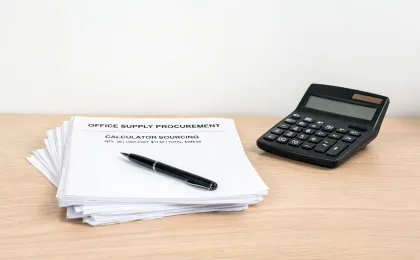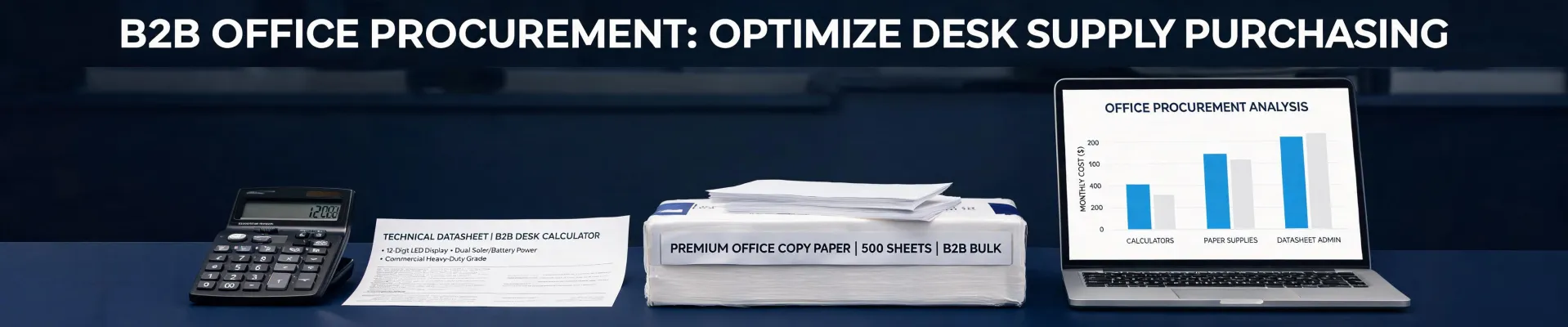
When I took over purchasing in 2020, I thought the hardest part of office procurement would be vendor negotiations. It wasn’t. In 2022, I ordered 40 scientific calculators for a company-wide training day. I compared specs, picked a model that fit the budget, and thought the decision was done. Two hours before the session, a trainer called: “These are all showing fractions. How do I make them show decimals?” I didn’t know. Neither did the trainer. The calculator was a Casio, and the default fraction display surprised everyone in the room.
That moment could have been a one-off. Instead, it became the reason I stopped treating office calculators like ordinary supplies.
The Surface Problem: Calculators Look Like Low-Risk Office Supplies
I manage purchasing for a 400-person company across three locations—roughly 60-80 orders a year across 8 or so vendors. I report to both operations and finance. In a typical year, I order everything from Brother printer toner to FlexiSpot standing desks. In that context, a scientific calculator looks like a small, low-risk line item.
But there’s no such thing as a “standard” scientific calculator. When someone emails asking for a calculator scientific casio, they might mean a basic classroom model, a graphing calculator, or a printing desktop unit. Those products have different menus, key layouts, and defaults. Picking one “calculator” from a spec sheet isn’t the same as picking a tool that works for your team. Most requests I get don’t mention a model number. They just say “scientific calculator,” which means the real decision is left to me—without knowing whether the user needs graphing, fraction keys, or just basic arithmetic.
The Deeper Problem: It’s Not About the Hardware
People assume all scientific calculators are the same. What they don’t see is the gap between the feature list and the user’s mental model.
Here’s the specific version I keep running into: Casio calculator fraction to decimal. Many Casio scientific calculators default to showing answers as fractions. To switch to a decimal, you need to know the S↔D button or change the setup. If nobody explains that, people think the calculator is broken. It isn’t. It’s just behaving differently from a phone calculator, which always returns a decimal.
I’m not a mathematician, so I can’t speak to the design philosophy behind that default. What I can tell you from a purchasing perspective is that this kind of small UX mismatch creates a support loop. The IT team gets the same question over and over. It’s the same pattern as “how do i connect my hp printer to wifi”—the hardware is fine, but the setup knowledge is missing.
The deeper issue is that we buy equipment without buying the basic user capability. In our office, we standardized on Brother printers for the back office and added FlexiSpot standing desk rows in 2024. Those purchases worked because the setup was straightforward. The calculators didn’t. Nobody needed to learn how to use a sit-stand desk, but they did need to learn a menu sequence.
Another layer I didn’t see at first: model fragmentation. We had one desktop printing calculator in finance, one graphing model in engineering, and a basic scientific model in training. Each one had a different menu. A user who remembered how to get a decimal on one model couldn’t transfer that knowledge to another. That made every new model a mini training project.
The mental model issue compounds it. Most people now use calculator apps that display decimals automatically. When they pick up a physical scientific calculator and see 1/2 instead of 0.5, they assume it’s defective. That mismatch causes more confusion than any hardware fault. And the documentation that ships with the calculator is usually a quick-start guide, not a daily-use guide. It tells you how to reset the device, but not how to change a default display setting. That’s the small gap where support requests live.
The Real Cost of Ignoring This
A single calculator support request doesn’t look expensive. Maybe 15 minutes of someone’s time, if they know the answer. But most people don’t, so it becomes a chain: user asks one person, that person tries it, then asks a colleague, and eventually someone opens a video tutorial.
In our 2024 vendor consolidation project, I counted 30 calculator-related requests. Let me correct myself: it was 28. I’m mixing it up with printer requests. Either way, the time added up. At a fully loaded cost of maybe $35 per hour, 28 requests at 20 minutes each is roughly $325 in internal time. That doesn’t sound huge, but it was more than the calculators themselves cost from the discount reseller. It also didn’t include lost training time or frustration.
The other cost is less obvious: trust. When equipment doesn’t behave the way people expect, they blame the equipment. Then they avoid it, or they ask to buy something else. I’ve had managers request a different brand because they didn’t know the decimal shortcut existed. That’s an expensive misunderstanding to fix.
There’s a compliance angle too. If people are using calculators for financial formulas, a fraction mistaken for a decimal can create bad numbers. I’m not an auditor, so I can’t speak to the financial risks in detail. What I can tell you is that better purchasing would have prevented the confusion before it reached the spreadsheet.
Never expected a calculator to be the purchase that taught me the most about vendor evaluation. But it was. In 2021, I ordered from a new vendor because the price was about $150 lower than our usual supplier. The calculators arrived fine, but the invoice was handwritten. Finance rejected the expense report. I learned that the lowest quote is not necessarily the lowest cost.
A Short Fix That Worked
By 2025, we didn’t spend more money on calculators. We spent more attention on the buying decision. At least, that’s been my experience with a mid-size company.
- We picked one Casio scientific calculator for general staff and one for engineering. Fewer models meant people could help each other across teams.
- I ordered a single unit before buying 40. That test revealed the fraction-to-decimal issue before it became 40 support tickets.
- We checked vendor capabilities before ordering. Per FTC guidelines (ftc.gov), advertising claims must be truthful and substantiated, so if a vendor called a calculator “durable” or “exam approved,” I asked for proof. And per USPS pricing (usps.com), a First-Class Mail letter was $0.73 as of January 2025—verify current rates if you’re mailing setup guides to remote staff.
That changed how we handle everything from Brother printer supplies to FlexiSpot standing desk accessories: if we can’t explain how to use it in two minutes, we either choose a simpler option or build a quick-start guide.
I’m not saying every office should standardize on one calculator model. I am saying the fundamentals haven’t changed—a calculator needs to be accurate, durable, and readable. But the execution has transformed. What was best practice in 2020 may not apply in 2025. The device is easy to buy. The work is making sure it actually works for the people using it.
That, more than the price tag, is what makes a calculator purchase succeed.

Elena Baptista
Elena Baptista is an office printing and imaging analyst covering laser and inkjet printers, multifunction devices, copiers, label and receipt printers, ink cartridges, toner cartridges, and drum units. She applies ISO/IEC 24734, ISO/IEC 24711, and ISO/IEC 19798 methods while comparing print speed, first-page time, duplex throughput, duty cycle, page yield, coverage assumptions, resolution, color consistency, energy use, and maintenance intervals. Her guides help offices, schools, dealers, and procurement teams match output volume, media handling, connectivity, consumable economics, service access, and fleet-management requirements.